Last Updated on September 15, 2025 by Tejaswini
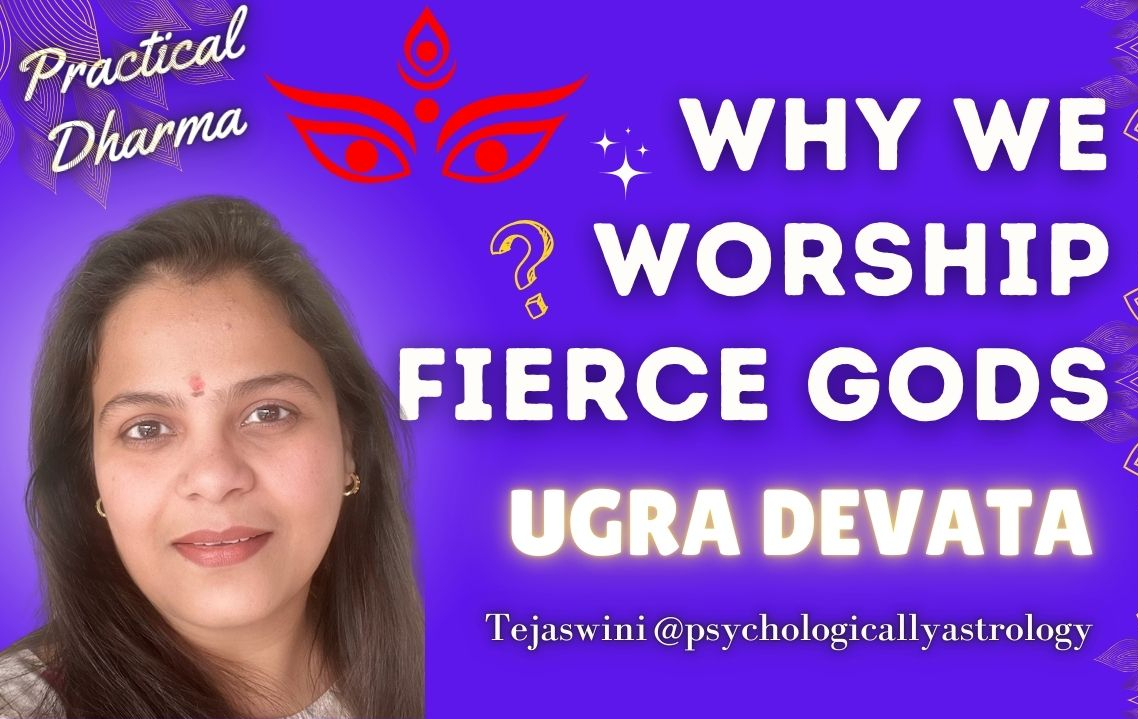
Why do some of us worship Ugra devata, ferocious deities instead of the gentler Saumya deities?
Sanatan Dharma is highly logical, Astik Darshan Shastra, it points you towards your own Reality. And there are no superstitions here, everything we do has a clear and specific reason. Hinduism is designed in a way that it expands your intelligence and simultaneously makes is subtler. And it is in two steps, Vedpurva and Vedant.
Vedpurva is the junior school of Sanatan Dharma. In this phase you are required to balance your Annamaykosh – physical body, Pranmaykosh – pranic body of naadis and pran movement and the Manomaykosh – the emotional mind. This might take one life or several lives but you have to be here till you gain control over these three layers of your body. Vedpurva does this through Moorti puja and karmakaand and later upasanakaand. This is compulsory. And Hinduism offers a beautiful pantheon of deities which you can worship as per your choice.
- There is Devi Laxmi of the Satva gun wearing a lovely sari, gold jewellery seated on a lotus, smiling, showering the universe with gold.
- Then Devi Parvati of the Tamo gun seated on her husband’s left thigh and holding her two children, Shri Ganpati and Shri Skandha in her own lap, her serene face glowing, the divine family together in one image.
- And Devi Sarasvati of the Rajogun, seated on her beautiful white swan, playing the Veena, holding her Mala and the four Ved in her hands, absorbed in the divine music she herself is creating.
- Their husbands, Bhagwan Brahma serene in meditation seated on a lotus.
- Bhagwan Vishnu in yognidra resting on the Shesha Naag, in the Ksheersamudra.
- Bhagwan Shankar deep in samadhi on the Mount Kailas.
- The Para Devi Lalita, the Mahatripursundari, Devi Kaamaskshi herself, resplendent in the most beautiful throne room of the universe.
- And then there are the parents of this universe, the Mahakameshwar and the Mahakameshwari.
These beautiful forms are the saumya forms of the deities. The deities are shown to be smiling, serene, eager to be pleased, willing to give blessings and very approachable. Their pujas are simpler and even if you do some mistakes these Saumya forms are willing to forgive. If you are just starting on the route shown by Sanatan Dharma then it is advisable to worship a saumya form. 99% of us worship these gentle forms.

And then there are the 1% followers of Sanatan Dharma who worship Ugra forms. like Bhagwan Kaalbhairav or Devi Chamunda, Devi Dhoomavati, Devi Bagalamukhi, Devi Tara, Devi Chinnamasta or the Primal Devi of Creation, the highest form of pure consciousness Devi Kali.
Worshipping these Ugra forms requires immense mental discipline. Take this up only if you have complete control over your emotions. These forms are very strict. It is like walking on the razors edge, one tiny slip can have disastrous consequences which can even go on for several lives. But if you are prepared, then it is only these Ugra forms which give you what you really want. The most precious secret of Sanatan Dharma, the secret of Moksh, immortality, freedom, knowledge.
Devi Mahakali is the same Devi Parvati/Laxmi/Saraswati/Lalita but now in Ugra form, as she destroys the concept of Kaal itself in the highest Mahashmashan. Here she shows you that there is no time, no space, Just the Self. And you are that Self. Devi Kali in her relatively gentle Dakshinkali form is terrifying to most people. And in her fierce Shmashankali form, just reading her descriptions will give regular people nightmares. She is the highest energy possible in this universe but for 99% of us, her power is too much to comprehend. The entire concept is so mindbending that 99% people do not dare stand in front of her. So you will find that most people are generally satisfied worshipping her relatively gentle form – Devi Lalita etc.

We worship Ugra devatas because facing and then acknowledging Reality requires tremendous amount of courage. Saumya forms give emotional strength and Ugra forms help develop intellectual strength. To know, understand and accept the core principle of Existence, Astitva requires tremendous courage. Which can come only with the worship of Ugra forms of the devatas.
Our deities are depicted with ‘lakshan’ ie the descriptions are indicative of a concept. Eg Black skin means that she is beyond the illusion of creation, she has no attributes, she is pure Existence, astitva. She has consumed Kaal/Time itself and is the unchanging Self. This is the foundational truth of Sanatan Dharma which is depicted through the moorti for easier understanding.
But the fact remains that the fundamental ‘god’ Intelligence of this Universe is in the ‘Ugra’ form. So let’s take another example of the Ugra form from a more familiar text, the Bhagawat Gita.

Today everyone accepts the truth of this Bhagwat Gita. It is from the Itihas Mahabharat, composed by Maharishi Vedvyas. Some consider it as a ‘song of the God’, some think it to be the ‘best management practice’ some consider it as a ‘yogshastra’. But primarily it is a distillation of the Vedant presented in a way that the even householders/ Gruhastashrami people can understand. And it also hides within it the deepest secrets of Shri Vidya.
Open chapter 11, here the ‘god’ of the Bhagwat Gita has been described in depth..
Here Shri Krishna shows Arjun the Vishvaroop. The moorti of the Parameshwar with infinite heads, infinite faces. It has infinite mouths all which are open and emitting fire. It has infinite arms moving in different directions. There are infinite legs all moving in different motion. It has infinite bodies of all possible looks, colors, shapes. It holds infinite types of weapons and all are ready to strike. It wears infinite clothing in every possible variation. It is adorned by infinite jewellery, infinite fragrances. This Vishwaroop is stupendous, radiating with fire of infinite suns, indescribable.
Here Shri Krishna shows Arjun how everything of this created worlds, even the the deities, the sages, humans, animals, the entire creation is itself continuously being swallowed by the infinite mouths of the Vishwaroop. His infinite teeth crushing all creation to nothingness. And Arjun’s mind then started crumbling face to face with this – Naked Reality. This is the ‘god’ of the Bhagwat Gita, it is pure Astitva. The Kathor Satya. The Essential Tama.
Arjun was a Maharathi, perhaps the greatest warrior of his times. He was great in every way! A Kshatriya, he knew how to use weapons, he had fought wars, bravely faced his enemies, humans and demons. He had done rigorous pujas, intense tapah, he had pleased the devatas, he knew secret tantra – mantras and yantras. He had learnt several lethal mantra weapons – Astra. He had won against armies stronger than him. He had seen unimaginable riches and also unimaginable insults in his life. Yet, despite all this life experience, he was unable to face the brilliance of the Vishwaroop. He thought that his mind would go insane, he requested Shri Krishna to stop.

Shri Krishna was a Atmajnyani Mahapurush, a Guru. He gave Arjun the ‘eye’ with which the Vishwaroop could be seen. Even today when a real Atmajnyani Guru gives his student the diksha for Moksh, he/she shows the student this glimpse of the Self. And it is this glimpse which then relentlessly drives the student to strive, to make this his own permanent reality.
The lakshan of this Vishwaroop is not different from the lakshan of Devi Mahakali. Krushna is not different from Kali – this is the ‘blackness’ without attributes. This is the Tama of the Naasadiya Sukta.
The ‘god’ of the Bhagwat Gita is the Primal Intelligence, and essentially in the Ugra form. But to understand what is being shown by these Ugra forms requires that you follow the step wise syllabus of sanatan dharma. To prepare your mind to accept the mind bending reality of your own Self.
So first do karmakaand, follow Ved Purva. Strengthen your physical body and your pranic body – do your Yogasan, eg Suryanamaskar, do Pranayam. Strengthen your emotional mind your maanas. Worship the Saumya deities and then understand what the Ugra deities are showing you. Understand the vedant, the Jnyan kaand from a Atmajnyani Mahapurush. Use your intellectual mind, your vijnyanmaykosh, your buddhi to inquire into your own Self. Once you are sure about who you really are, do the ‘practicals’ given in the Upanishads. These ‘practicals’ are rewritten in a comparatively simpler language in the Tantra books under the Shri Vidya umbrella. Rooted in theory, master the practicals. And see for yourself where all this takes you.
Hinduism is not a religion nor a doctrine nor a philosophy nor an idea. There is no ‘supernatural creator god’. You create your own universe in your mind.
Walking this Sanatan dharma path to the Self requires tremendous courage. There is no concept of retribution, no guilt, no compulsion, no punishments in Sanatan Dharma. The law of Karma operates and you yourself, your own conscience, Antar-atma is in charge. As you act with intention you simultaneously create its result, which you yourself have to enjoy/ endure. Whatever happens to you, it is because of you, no one else. You cannot blame anyone, you have to take responsibility for yourself. Sanatan Dharma does not allow you to blame others, and this makes it the most difficult path to follow. And it also gives the greatest final prize – the Self.
So if you feel inclined, start on this path. it may take one life or a million but once you step on it, the result is assured. And the prize is well worth the effort!
Dr.Tejaswini Arvind Patil
(Now do think on why knowing the Self is so essential.. )


Leave a Reply to TejaswiniCancel reply