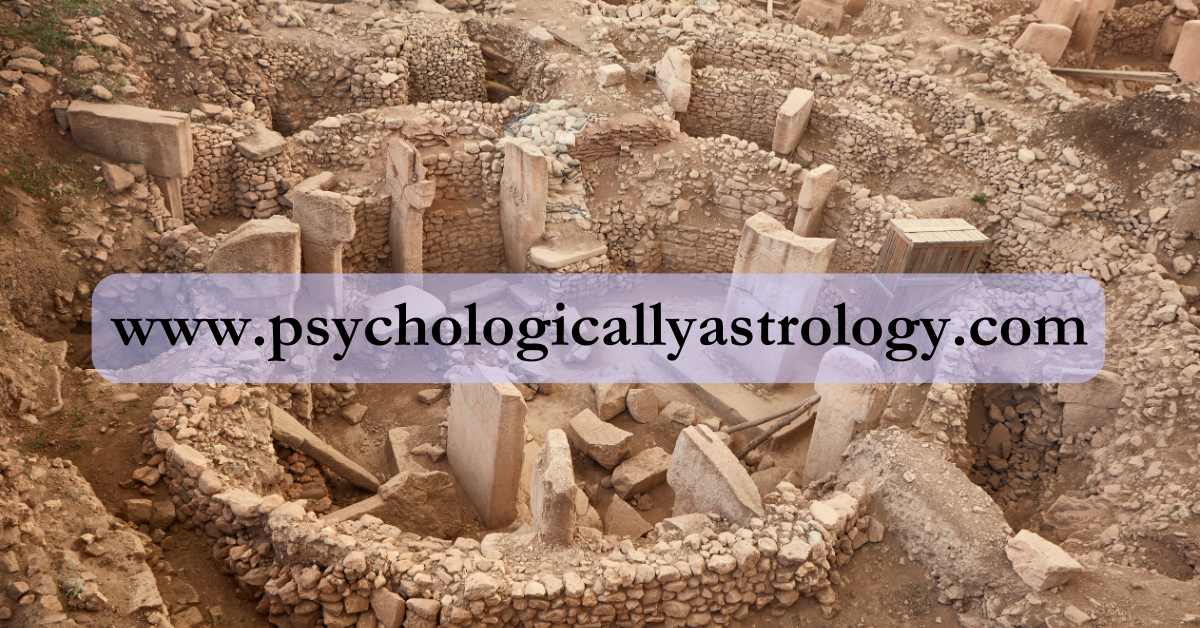
Gobekli Tepe is an ancient archeological in Turkey. It is in the news because the archeologists have discovered signs of a Dharmic civilisation in this site. Shivlingams, carvings which look like Hindu deities etc. Also these excavations show that ‘religion’ came first and then ‘technological’ progress which is opposite of the currently accepted theories on human evolution. These excavations show that people of that age had access to advanced knowledge and also the use of such knowledge. And these findings have shocked the archeologists, turning their theories around. Their current understanding is that the site is about 11000 yrs old, when in fact, it could be older. The Gobekli Tepe site has artefacts in several layers. The older layers are buried beneath the relatively newer layers and all are thousands of years old. This indicates that this site was continuously occupied for several generations of people. The Gobekli tepe area was a thriving centre of civilisation, learning, knowledge for generations. And today it is giving these archeologists, new insights and also new questions to ponder upon.
On a side note, all the cities of Bharat /India are also similarly in layers. All our cites, from the north to the south, from the far east to the west are living history. We will have to excavate under all the major cities of this nation to reveal the real history of our land. For eg our capital New Delhi / Indraprastha has been continuously occupied at least since the Mahabharata events. Over 8000yrs of history hidden underground beneath its roads. It is fascinating to my mind that Bhagwan Shri Krishna and his cousins, Pandavs, Kauravs actually lived in Delhi. And who know what artefacts from that age are right under our feet, as we walk around in Delhi.

Back to Turkey. Let us use words to trace the history of Gobekli Tepe. Language always retains the impressions of history. Everything else can change but language, the words, can give a glimpse of hidden history.
The site is called ‘Portasar‘ in Armenian. This is its oldest name and is translated as the ‘Navel mountain’. ‘Navel’ is a common theme in Sanskrit. It indicates the concepts of – Creation, Bhagwan Vishnu, Bhagwan Brahma, Mountain Meru, Lotus, Time etc. The word ‘Portasar’ is a combination of two pure Sanskrit words.
1. Porta – There are 3 options here which fit in the context.
- So Porta can be a distortion of the word – Purta पूर्त – rewarding, merit, perfection, completion, fullness etc.
- Or it can be a distortion of – parata – परत – far, highest, beyond everything etc.
- Or it can be a distortion or Paurta पौर्त – meritorious activity, charitable actions or rewarding work.
2. Sar can be ‘sar’ or ‘saar’, both are pure Sanskrit words and both fit the context.
- Sar सर – line, movement, motion, milk, nourishing essence.
- Saar सार – stretching out, power, pure essence, sound, riches, precious nectar.
This site has another ancient name in Kurdish – Giri Mirazen
- ‘Giri’ is a pure Sanskrit word – it means a mountain, raised ground, a respected person, wise person.
- Mirazen can be divided into two words ‘Mir and ‘Azen’.
- Mir is a pure Sanskrit word, it means an ocean. But in this context, Mir is most likely a distortion of ‘Meru’. The Meru in Sanatan Dharma can be understood in several ways. First is the concept of a physical mountain. Several mountains in the world are named after ‘Meru’. And on the energy level Meru represents the multi-dimensional Shri Yantra, which is the fundamental geometry of the universe. It is the energy of of creation, sustenance, dissolution, recreation and transcendence of the universe.
- Azen can be a distortion of अश्न Ashna which means – stone or mountain rocks.
- Or Azen can be a distortion of Asan which means – seat, place, location, the seat used for doing tapas/ meditation, yogic posture. The Asan is the foundation you use to achieve something truly extraordinary.
Then the name Gobekli Tepe is Turkish. It is said to mean ‘Potbelly hill’ and is a the relatively recent word for the site. Let’s see if we can find Sanskrit roots hidden in it.
- I referred to a Turkish language dictionary and ‘Gobekli’ or ‘Gobek’ mean a belly, navel, midpoint, generation, head, hub, center and most interestingly – a rotary. ‘Rotary’ is to turn around like an axis on a wheel. So the word ‘Gobekli’ in Turkish means a – central, creative and supportive axis. This is exactly what the Meru means.
- Also it is possible that the Armenian concept of ‘Navel mountain’ was directly converted into its Turkish equivalent concept ‘Gobekli Tepe’.
- But the root word here is ‘Go’. This is a pure Sanskrit word which has hundreds of meanings – the primordial sound seeds, sound, moon, sun, stars, creation, cow, earth, thunderbolt etc.
- Then Tepe in Turkish means a top, peak, hill, head, etc and also a topknot. One of the artefacts found in a nearby site show a head carved with a Shikha/ topknot. Even today, all Hindu men who wear a Yajnopavit sutra wear their hair in this exact topknot/ Shika style.
- Or ‘Tepe’ in Turkish, is a distortion of the Sanskrit word tapa (तप). which means – sun, heat, spiritual fire, fire of knowledge, activities done in pursuit of knowledge, research, mound etc.
Interestingly the artefacts excavated in the site mirror the history recorded in the Purans of Sanatan Dharma. The images record images of disasters, floods, serpents etc. The images of these artefacts are all over the internet now, so you can study them for yourself. Followers of Sanatan Dharma will have no difficulty in recognising images of the Dasha Avtar of Bhagwan Vishnu, Garuda, Surya dev and Chandra dev, etc.

So Portasar, or Giri Mirazen or Gobekli Tepe, these words all mean the same thing. A high place where respected people who wore their hair in topknots/ Shikha lived. A center for learning, for doing research, for keeping records. A place where the energy which keeps this earth rotating on its axis is centred. Or a place where the conscious energy which creates this universe can be studied and understood. A hub of learning. A place where meritorious, rewarding and useful high energy activities were regularly performed for thousands of years.
Thus to make sense of these Gobekli Tepe artefacts the western researchers have to accept that originally, the entire world followed Sanatan Dharma. And Sanskrit is the original mother tongue of every conscious being on this earth. Most of us have forgotten Sanskrit, very few remember it. And even fewer utilise the power of Devbhasha Samskrutam in our regular lives. This is the perfectly arranged definition of Light, Intelligence, Consciousness, the Self. Sound is Power, Consciousness.
Every living being on this earth has a right over Sanatan Dharma and its Devbhasha Samskrutam, if only they would understand, accept and utilise this. At present only a few pockets in India, Nepal and a handful of other nations follow Dharma. These are the few last remnants of Dharma. All the other regions of the world have forgotten their real roots. Of the 8 billion or so humans on this earth, only 15% follow Dharma. And as per the ‘rule of the majority’, the current global thought process is not Dharmic. Thus the researchers may not really understand what they are seeing at Gobekli Tepe.
As people forget who they are, everything around them slowly and irreversibly changes. And the slowest thing to change is the words they use, the language they speak and the concepts hidden in it. Thus we can most easily trace the history of a place or of a people by tracing their words, their language and their life concepts.
Do learn Sanskrit, it is your right. It is the right of everyone on this Earth. Make use of this Divine Language to trace your roots.
I am neither an archeologist or a specialist in this field. I just know to read Sanskrit and think. Anyone who knows Sanskrit, do read through the names of the really ancient sites, old cities, rivers, in the world. You will be able to glean the Dharmic and Sanskrit roots hidden in these. If you want, as an exercise – list out the names of the places, rivers, mountains which have – nag, naag, sar, saar, meru, sthan, durg or its distortion ‘burg’, etc basic Sanskrit words hidden in them. Sanskrit is everywhere, hidden but easily visible if you are interested.
Dr. Tejaswini Arvind Patil


Leave a comment